

Shell and Tube Heat Exchanger: Design, Applications, and Benefits
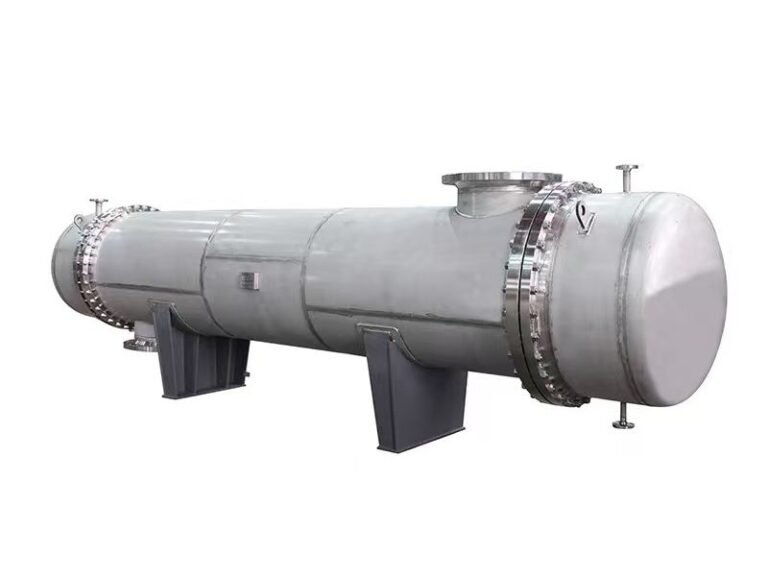
What is Shell and Tube Heat Exchanger?
Shell and Tube Heat Exchangers (STHE) are among the most widely used heat exchangers in industrial applications due to their durability, efficiency, and adaptability to high-pressure and high-temperature environments. They are crucial in industries such as power generation, oil & gas, chemical processing, and HVAC systems.
This blog explores the structure, working principle, types, advantages, and common applications of Shell and Tube Heat Exchangers.
How Does a Shell and Tube Heat Exchanger Work?
A Shell and Tube Heat Exchanger consists of multiple tubes enclosed within a cylindrical shell. Heat transfer occurs as one fluid flows inside the tubes (the tube side) while another fluid circulates outside the tubes but within the shell (the shell side).
Key Components:
- Shell: Outer pressure vessel containing the tube bundle.
- Tubes: Thin-walled pipes where one fluid flows (typically the process fluid).
- Tube Sheets: Plates that hold tubes in place and separate shell-side and tube-side fluids.
- Baffles: Internal plates that direct shell-side fluid flow, improving heat transfer efficiency.
- Inlet & Outlet Nozzles: Entry and exit points for fluids.
Fluid Flow Configurations:
- Counter-Flow (Most Efficient): Hot and cold fluids move in opposite directions, maximizing temperature difference and efficiency.
- Parallel Flow: Fluids move in the same direction (less efficient but simpler design).
Types of Shell and Tube Heat Exchangers
Based on construction and fluid flow arrangements, STHEs are classified into:
Fixed Tube Sheet Exchanger
- Tubes are welded permanently into tube sheets.
- Simple and cost-effective but difficult to clean.
- Best for clean fluids with minimal thermal expansion issues.
U-Tube Exchanger
- Tubes bend into a U-shape, allowing thermal expansion without stress.
- Only one tube sheet is used (easier maintenance).
- Common in high-temperature applications (e.g., steam systems).
Floating Head Exchanger
- One tube sheet is fixed; the other floats to accommodate thermal expansion.
- Ideal for extreme temperature differences.
- Allows easy tube cleaning and replacement (most versatile).
Kettle Reboiler (Specialized STHE)
- Used in distillation columns to vaporize liquids.
- Features a widened shell section acting as a vaporizer.
Industrial Applications
Shell and Tube Heat Exchangers are indispensable in industries requiring robust heat transfer solutions:
Oil & Gas Refineries
- Crude Oil Cooling: Prevents overheating during distillation.
- Natural Gas Processing: Condenses hydrocarbons or cools compressed gas.
Power Plants
- Steam Condensers: Converts turbine exhaust steam back into water.
- Feedwater Heaters: Boosts boiler efficiency by preheating inlet water.
Chemical & Petrochemical Plants
- Reactor Cooling: Controls exothermic reactions safely.
- Solvent Recovery: Condenses volatile chemicals for reuse.
HVAC & Marine Applications
- Chilled Water Systems: Cools large buildings or ships.
- Lube Oil Coolers: Reduces engine oil temperature in heavy machinery.
Project Details
Date:
January 16, 2026
Categories:
Factory, Industry, Manufacturing
Link Project:
http://
Contact Info
- 99 S.t Jomblo Park Pekanbaru 28292. Indonesia
- +86 15252610825
- dolly@xuyangsang.com